A creator sends you a 9-minute clip. The ad needs 4 seconds of it.
If your system is "Drive folder per creator, subfolder per month", those 4 seconds are still inside the 9 minutes, and somebody has to scrub for them. Every time. For every variation. For every editor.
I've been behind $50M+ in Meta ad spend, and this was the same at every brand I did creative strategy for. The footage was fine. Finding it was the problem.
So, how do you organize creator footage properly:
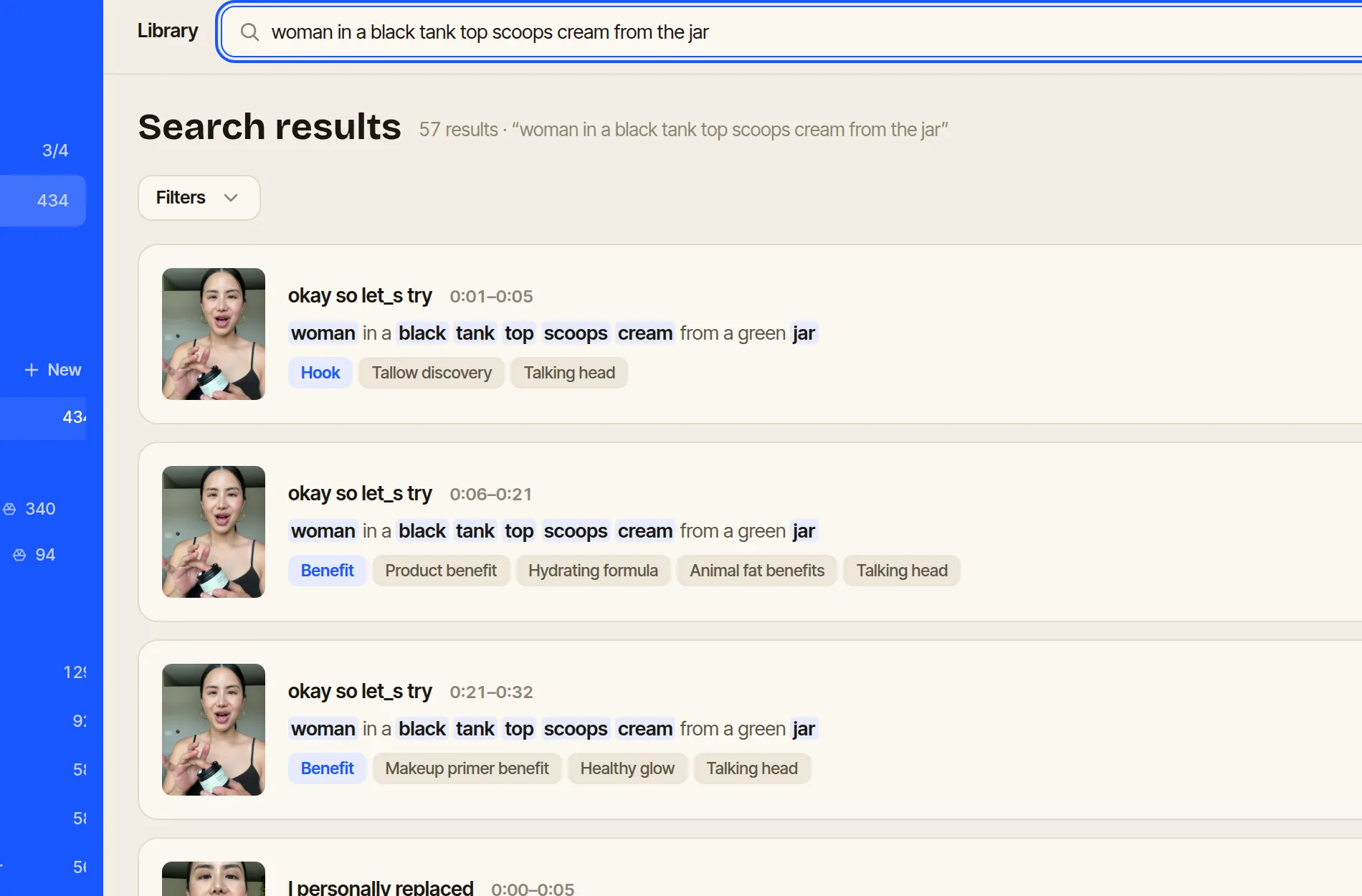
What the end state looks like: you type the brief, you get the moments.
Why don't folders work for creator footage?
Because a folder answers the wrong question. It answers "who sent this and when". Nobody briefs an editor like that.
An editor gets briefed like this: "give me the take where she says she was skeptical, outdoors, and a product close-up to cut to."
That brief has three parts. What's said. Where it's shot. What's shown. A folder knows none of them. So the editor opens the folder, watches everything once, and keeps private notes. Which works until they leave.
Idea: the unit you organize has to be the segment. One hook. One demo. One testimonial line. One b-roll action. A 9-minute clip is usually 20-40 segments. Those are the things you search for, so those are the things you store.
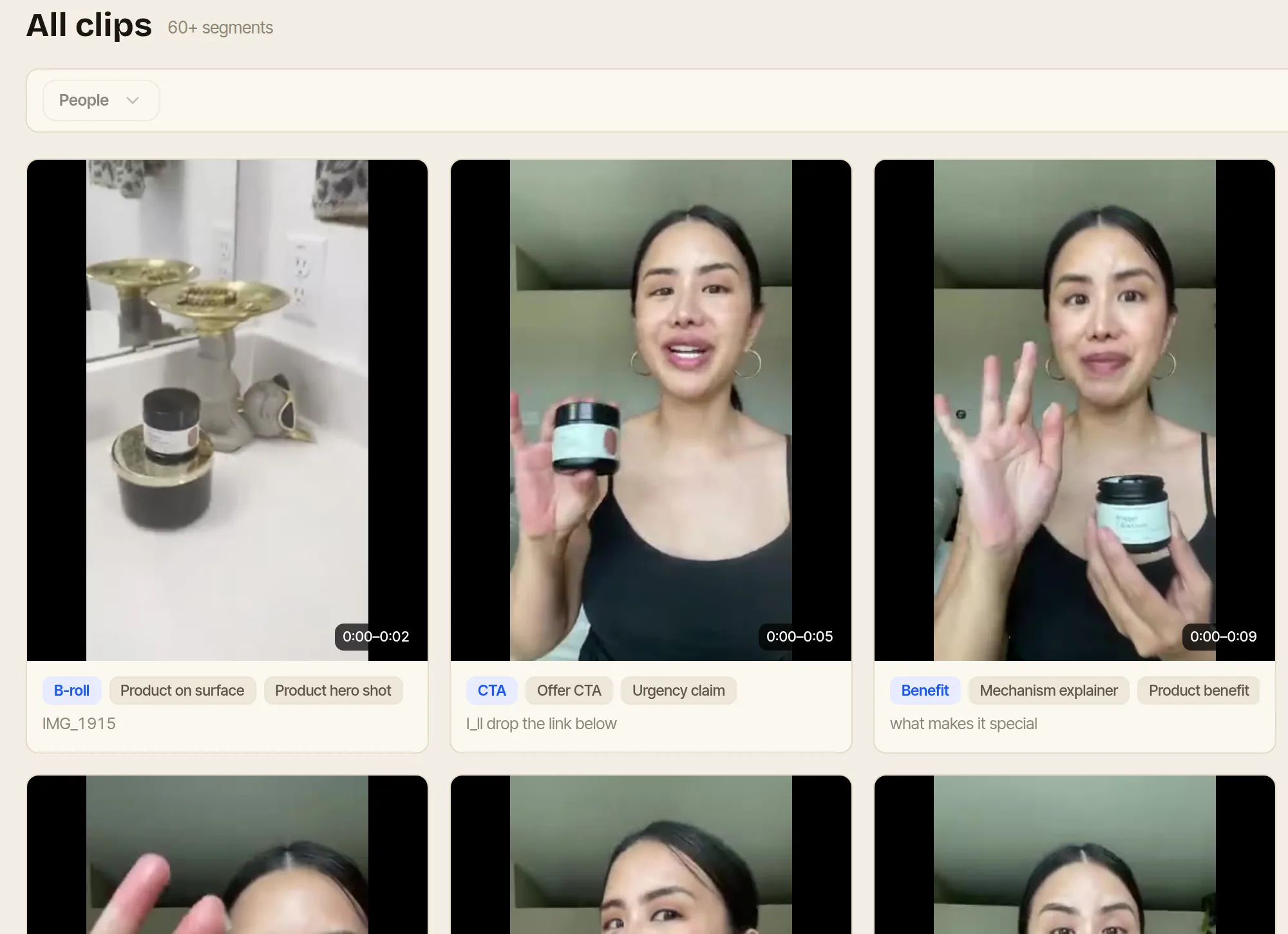
One creator clip, cut into its moments. This is the unit.
What should the library know about every moment?
Four things, and they map to how briefs are written:
| The brief says | The library needs | Where it comes from |
|---|---|---|
| "the take where she says X" | the transcript, with timestamps | speech-to-text on upload |
| "a close-up of the dropper" | a description of what's on screen | AI watches each moment |
| "the one with Maria" | who is on camera | face index, with consent settings you control |
| "a hook", "a testimonial", "b-roll" | the segment type + category labels | the analyzer, against your label list |
If any row is missing, one kind of brief becomes a scrub. Most tools stop at row one (transcripts). Row two is what makes "dropper close-up, clean background" a search instead of a Slack thread.
Do I really need to transcribe everything?
Yes. This is the step most brands skip because it feels like extra work. It's the opposite. The transcript is around 70% of your search.
Most of what makes a creator clip usable is in the words. "It absorbed in ten seconds." "I was skeptical at first." "My old pan was scratched to death." With the transcript and timestamps, you find every one of these across 200 clips in seconds.
Quick Example: you want every take where a creator mentions sensitive skin. With transcripts, that's one search:
every take where the creator mentions sensitive skin
Without, it's a spreadsheet somebody fills in by hand and stops updating after two weeks.
Idea: transcribe at upload, with word-level timestamps. Not "later". Not "for the good ones". All of it, on the way in. If you use BuildYourAds this happens on upload; if you don't, any speech-to-text API with word timestamps works, as long as it runs on everything.
How do I tag footage for my category?
Generic tags are nearly useless. "Product shot" tells a cookware editor nothing. "Egg sliding off the pan" is a usable brief.
Every category has 10-15 moments that show up in every ad. Write them down once:
→ Cookware: searing, food release, pouring into the pan, wiping the pan clean, the scratched old pan → Skincare: texture on fingertips, dispensing, skin close-up, the mirror check, before and after → Supplements: the scoop, the morning routine, "two weeks in" → Appliances: turning it on, the result shot, the noise test, the old appliance comparison
Then tag every segment against that list. In BuildYourAds a skincare workspace starts with that list already, and the analyzer suggests new labels it keeps seeing in your footage. If you do it yourself, the rule is the same: one list, every segment, no exceptions.
The test for a good label: can an editor search it and cut the result straight into an ad? "Product in use" fails. "Food release test" passes.
How do I keep the people searchable?
Brands with 30 creators lose track of who is who inside a month. "The one with the curly hair who did the unboxing" is a real brief I've heard.
Idea: index faces (with consent settings you control) so "every clip with Maria" is one click, and combine it with what she says or wears.
every clip with Maria where she talks about the price
This is also how you see which creators actually deliver usable moments and which ones deliver 9 minutes of nothing. More on that in the footage audit.
Why one library and not one per editor?
Here's what happens in most teams: editor A keeps a Notion doc of timestamps. Editor B has a folder called "GOOD STUFF". Editor C remembers everything and then leaves.
When any of them leaves, their system leaves too. The new editor starts from zero and re-watches everything.
Idea: the library has to be shared and the tags have to be the same for everyone. If it lives in one person's head or one person's folder, it isn't a system. I wrote up why this happens and what it costs in why every editor keeps their own folders.
Should I copy files into the library or connect the source?
Connect the source. If creators deliver to Drive, the library should read from Drive.
Copying files to a second place is the step people stop doing in week three. Then the library is three weeks behind, the editor stops trusting it, and everyone goes back to Drive.
Idea: connect the folder once. New drops get transcribed and tagged on their own. Your editor opens the library in the morning and last night's creator delivery is already searchable.
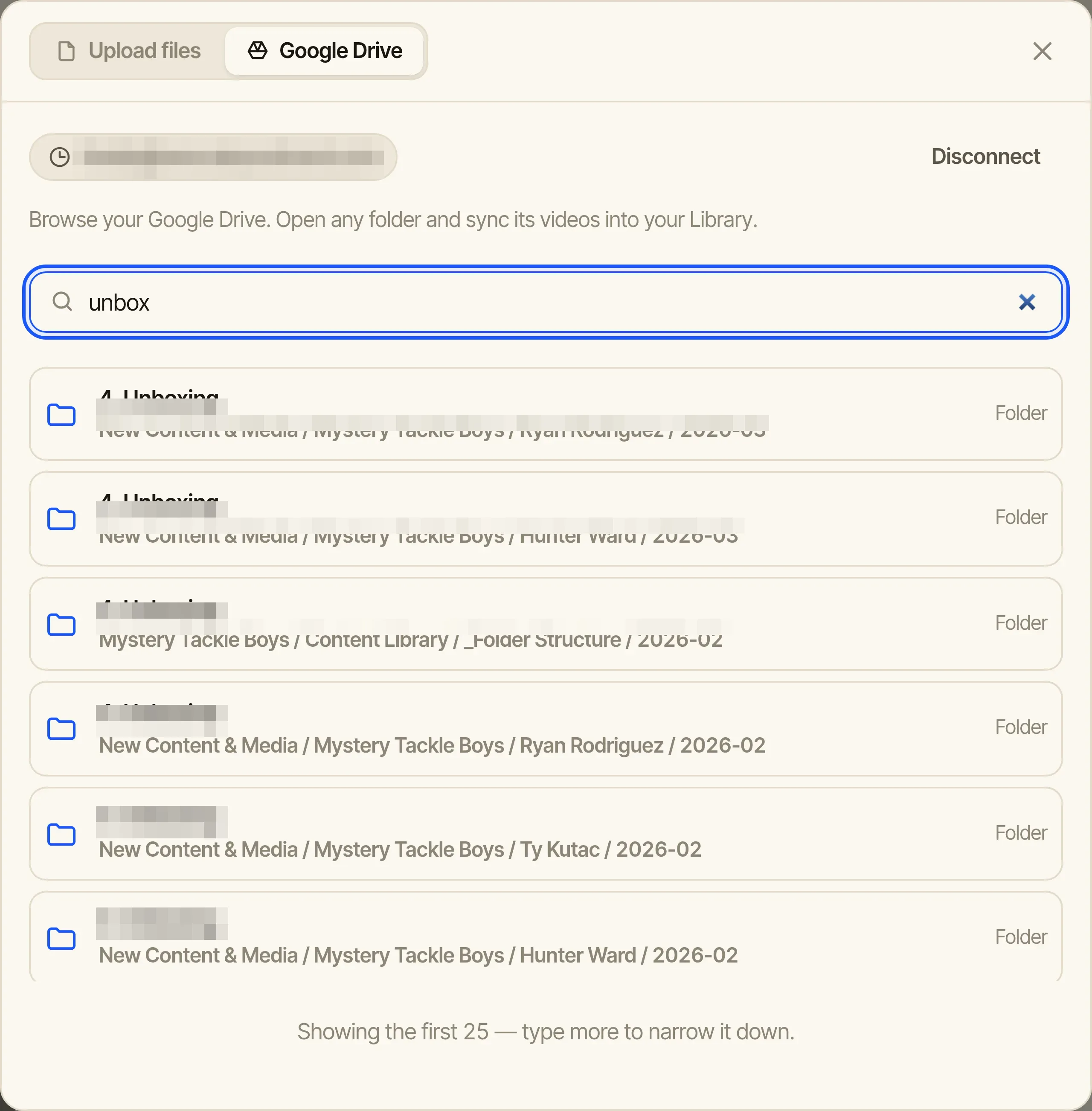
Connecting a Drive folder. Search by name instead of clicking through 200 folders.
What does this look like in practice?
Let's say you run a skincare brand with 25 creators. They send around 60 clips a month, 5-10 minutes each.
Old way: the strategist writes a brief from memory. The editor scrubs 3-4 hours per ad looking for the right takes. Half the footage never gets opened.
New way: the strategist searches "skeptical to convinced, outdoors" and gets 14 takes in 2 seconds. She picks 3 and puts the links in the brief. The editor pulls the exact segments into Premiere from a panel. The 3-4 hours become 20 minutes, and the footage you paid for actually gets used.
What doesn't this fix?
Three things, so you don't expect them:
Bad footage. A library makes good moments findable. It doesn't create them. If a creator sends 9 minutes of nothing, you'll find that out faster, which is useful, but it's still nothing.
Taste. The library gives the strategist 14 takes. Picking the right 3 is still the job.
The cut itself. Finding goes from hours to seconds. Cutting takes as long as it always did. That's fine. Cutting is the part editors are good at.
Your first two weeks
Week one: connect the Drive folder (or upload the last quarter of footage). Let it transcribe and tag. Don't reorganize anything by hand. Then run five real briefs as searches and see what comes back. Fix labels that feel wrong.
Week two: put links in one real brief instead of descriptions. Watch the back-and-forth with the editor disappear. Then install the Premiere panel for one editor and let them pull segments directly.
If after two weeks an editor still opens Drive first, the library is missing something. Usually a label. Ask them what they searched for and didn't find.
FAQ
Should I organize creator footage by creator or by product?
Neither, as the main structure. Organize by moment (segment) and keep creator and product as filters. A creator folder can't tell you which clips contain a usable hook; a segment library can, and it still shows you everything from one creator when you need it.
How long does it take to organize a backlog of creator footage?
With automatic transcription and tagging, a folder of 200 clips is usually searchable within the hour. By hand, most teams never finish, which is why the backlog exists in the first place.
What should I tag on creator footage?
The transcript (what's said), a visual description (what's shown), who is on camera, the segment type (hook, demo, testimonial, b-roll) and 10-15 category-specific actions like "food release test" or "texture on fingertips".
Can I do this in Google Drive or Dropbox alone?
You can store footage there. You can't search inside it. Drive searches file names and document text; it has no idea what happens at minute 4 of a video. Keep Drive as the delivery folder and put a library on top that reads from it.
Does this work for studio footage too, or only UGC?
Both. Studio days produce fewer, cleaner clips, but the same problem: the shot you need is at minute 11 of a 14-minute take. The segment structure doesn't care where the footage came from.
What about footage from an agency we stopped working with?
Upload it. It's usually the most unused footage a brand has, and it's already paid for. Most of it is fine; nobody has looked at it since the agency left.