A hook bank is a list of every hook you own, searchable, with a timestamp to the exact take.
Not a list of hook ideas. A list of hooks that exist, on video, said by a real creator, ready to cut.
Most brands think they need a new shoot to test 20 new hooks. I found they usually have 50+ hooks already, inside footage that was delivered months ago and never opened past minute one.
So, how do you build one:
What counts as a hook?
The first 3 seconds. Sometimes 5. It's the line or the shot that decides whether someone keeps watching.
In creator footage the hooks are everywhere, and they're usually not where the creator put them. A creator films a 6-minute review. The hook is the sentence at minute 4 where she says "okay, I did not expect that". She didn't plan it. It's still the best 3 seconds in the file.
The shapes that show up in every category:
| Hook type | What it sounds like | Where it hides in raw footage |
|---|---|---|
| Reaction | "wait, what?", "okay that's insane", the laugh | mid-take, right after the product does something |
| Claim | "this replaced three products for me" | usually said twice, the second time cleaner |
| Problem in the viewer's words | "my pan was scratched to death" | the creator's own intro, before the product |
| Pattern interrupt | the product doing something unexpected on screen | b-roll, no words at all |
| Skeptic | "I honestly thought this was a scam" | the first 30 seconds of a review |
Step 1: transcribe everything
You can't find a hook you can't read. Transcribe every clip with word-level timestamps.
This is the step that makes the rest possible, and it's the one most teams never do because "we'll do it for the good ones". You don't know which ones are the good ones yet. That's the point.
Step 2: tag the hook moments
Go through the transcripts and mark every moment that would work as an opening. Use the table above as the checklist.
If you do this by hand, budget around a minute per minute of footage. If you use BuildYourAds, the analyzer tags hooks as a segment type on upload and you skip this step.
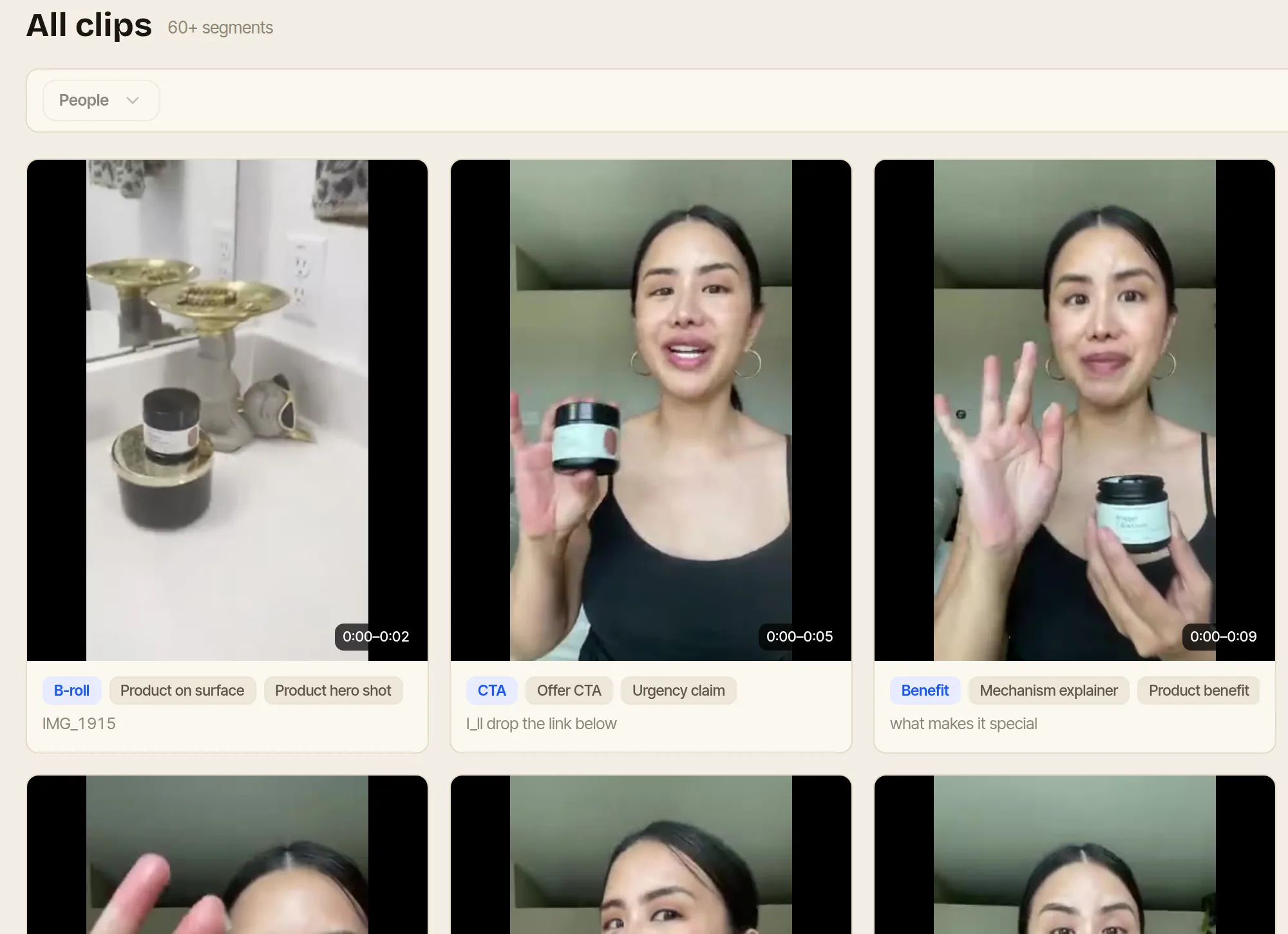
Hooks tagged as their own segment type, wherever they sit in the file.
Step 3: make it searchable by what's said
A hook bank in a spreadsheet dies in two weeks. Nobody updates it. Nobody searches it.
It has to be searchable by meaning. "Skeptical at first" should find "I honestly didn't think this would work" and "I was not convinced". Creators never say the same sentence twice, so exact-match search misses half of them.
These are the searches I'd run on day one:
creator skeptical at first, then convinced
reaction right after the product does something
creator describes the problem before mentioning the product
Idea: keep the bank inside the library where the footage lives, so a search result is a playable segment, not a row in a sheet.
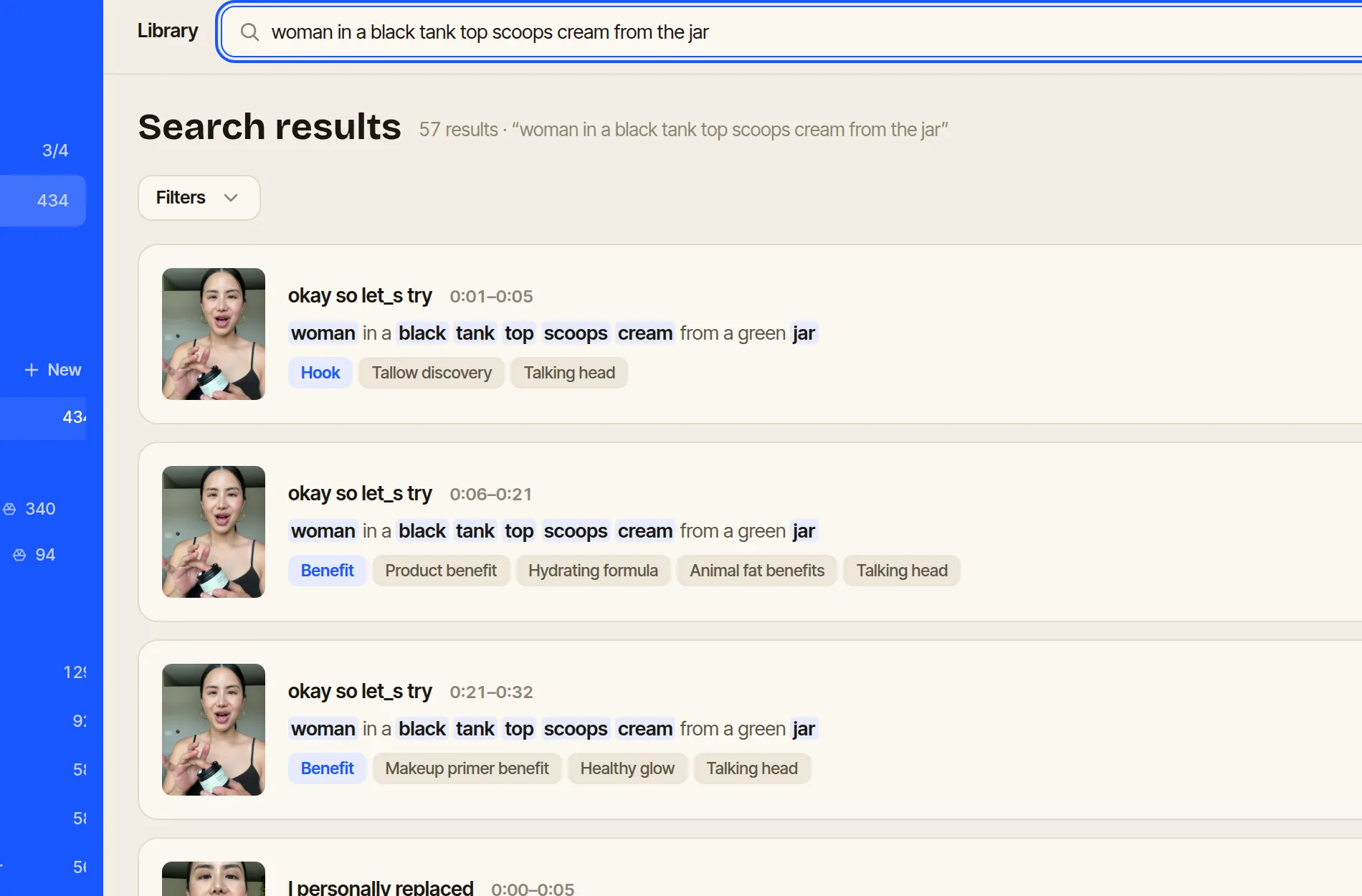
The hook bank is just a search. Every result plays from the right second.
Step 4: use it in the brief, not after
The hook bank changes how a brief gets written.
Old brief: "Hook: creator expresses surprise about the results." The editor now has to find that.
New brief: three links to three specific takes, already chosen by the strategist, with the one she prefers first. The editor starts cutting, not searching. I wrote the whole method up in brief your editor with links.
This is the thing that makes strategists more creative, by the way. When finding footage takes 20 seconds instead of an hour, you try more ideas.
Step 5: refill it from the data
Every ad you run teaches you which hooks work. Put that back in the bank.
Quick Example: you test 8 hooks. The two "problem in the viewer's words" hooks win. Next search in the bank: every take where a creator describes the problem before the product. You'll find 10 more you never tested.
What does a hook bank look like after a month?
Let's say you have 40 creators and 300 clips. After transcription and tagging I'd expect something like:
→ 80-150 hook-type segments → 10-20 you'd run tomorrow → 3-5 you didn't know existed and would never have found by scrubbing
That last group is where the wins come from. Nobody plans the best hook. Somebody finds it.
What the bank can't do
It can't tell you which hook will win. It gives you 20 candidates in 2 minutes instead of 3 candidates after a day of scrubbing. Picking and testing is still the job.
It can't fix a shoot where nobody said anything usable. It will show you that faster, which is worth something, but the fix is a better creator brief, not a better search.
Your first two weeks
Week one: transcribe and tag the last quarter of footage. Run the three searches above. Put every result you'd run into one place, with the link. That's version one of the bank, and it usually has more in it than you expected.
Week two: brief one test round from the bank only. No shoot. Five hooks, same body, same audience. Whatever wins, search for more of that shape and do it again.
FAQ
How many hooks should a hook bank have?
Enough to test without shooting. In my experience 30-50 usable hooks is where a brand stops needing a new shoot for every test round. Most brands with 20+ creators already have that many inside delivered footage.
Do I need new footage to build a hook bank?
No. Start with what's been delivered. New shoots add to it, but the first version of the bank should come from the footage you already paid for and never fully opened.
What's the difference between a hook bank and a swipe file?
A swipe file is other people's ads. A hook bank is your own footage, cut to the 3 seconds that open an ad, searchable by what's said. You can run something from a hook bank tomorrow.
How long should a hook be?
Under 3 seconds for feed and Reels. If the first sentence takes longer than that, cut into the middle of it. Most of the takes in the bank will need a trim at the front.
Can I build a hook bank in a spreadsheet?
You can start one. It stops being updated after two weeks in every team I've seen, because a row in a sheet isn't playable. The bank has to live where the footage plays.
How do I ask creators for more hooks?
Send them the list of hook shapes from the table above and ask for 5 of each, said differently each time. Then ask for the problem in their own words before the product comes out. That one line produces more usable hooks than anything else you can brief.